2012年11月14日 星期三

讀者文摘專輯第十一集(33則)

Reader's Digest


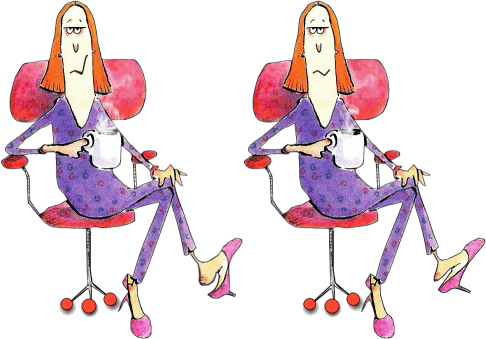
O A logger, fresh from the big woods, was watching a shop assistant open a package of gaily colored men's pyjamas.
"What's them?" he asked.
"Pyjamas."
"Pyjamas," echoed the logger. "What's are they for?"
"Why, you wear them nights," the shop assistant explained. "Want to buy a pair?"
"Nothing doing," said the logger, "I don't go anywhere nights except to bed."    (RD2014, Jan., p.107)
一位伐木工人剛從大森林裡出來,看到一個店員正在打開一個包裹,裡面是一堆顏色鮮豔的男用睡衣。他問道:「那是甚麼?」
「Pyjamas(睡衣)。」
他隨口應道:「Pyjamas喔...那是幹甚麼用的?」
店員解釋說:「嗯,那是人們晚上穿的衣服。要不要買一套?」
伐木工人說:「不用了...我晚上除了上床睡覺,啥地方也不去。」


O One of my co-workers where I used to work was in the reserve forces, and when he was deployed abroad, the boss placed this sticky note on his door: Stepped out. Back in 12 months.      (RD2014, Jan., p.87) 
我以前的一位同事隸屬預備部隊;當他被派到國外服役時,他的老闆在他辦公室門上貼了一張便利貼字條:「有事外出,十二個月後回來。」

O My neighbor, a police officer, pulled someone over for texting while driving. The driver was having none of it. 
"I was not texting!" she insisted indignantly. "I was on Facebook."      (RD2014, Jan., p.87)
我的鄰居是位警官,有一次攔查一個疑似邊開車邊發簡訊的駕駛人,但發現她根本沒在發簡訊。她很憤慨地說:「剛才我沒有發簡訊,我是在上臉書!」

O To register her child for our school, a mother filled out a number of forms. For the question "Language spoken at home?" she'd answered: "Generally good language, unless I get mad."        (RD2014, Jan., p.87)
有一位媽媽來我們學校幫她的小孩辦理註冊,填了一大堆表格;其中有一個問題問道:「在家裡講甚麼話(語言)?」她的回答是:「通常都講好話,除非我被惹火了。」

O I don't think cops should wear mirrored sunglasses. The whole time that the guy was chewing me out, all I could think was, I should really cut my hair.     Bonnie McFariane     (RD2014, Jan., p.49)
我認為警察們不宜戴反光的太陽眼鏡。每次我被他們訓斥時,我只想到一件事:我該去剪頭髮了。

O Whenever I see a man with a beard, a moustache and glasses, I think, Now there is a man who has taken every precaution to avoid people doodling on photographs of him.    Carey Marx     (RD2014, Jan., p.49)
我只要看到有人留著大鬍子,配上八字鬍和一副黑框眼鏡,我就會想:這傢伙故意弄成這副德行,恐怕是預防別人在他的照片上胡亂塗鴉的萬全措施。

O Never trust a mathematician with a graph. They are plotting something.    (RD2014, Jan., p.49)
千萬要提防正在畫函數圖形的數學家;他們正在進行某種陰謀。(譯註:這裡的plot是個雙關語,一方面是指畫圖的動作,一方面是圖謀不軌的意思。)

O Our employer installed a suggestion box in hope of easing the tension she feared might follow workflow changes. The staff's ability to keep the atmosphere light, however, was exemplified by the first suggestion.
Stuffed partway through the box's small slot was this advice: "Make this hole bigger."     (RD2013, Classic Reads, p.83)
我們公司老闆設置了一個意見箱,希望藉此緩和緊張關係,以免造成人事的不穩定。這項營造輕鬆氣氛的作法有了正面的回應;第一個建議寫在一張紙上,塞在意見箱狹小的開口,一半露在外面,上面寫道:「把這個洞開大一點!」


2012年10月8日 星期一

讀者文摘專輯第十集(35則)

Reader's Digest


O Best of enemies
Spotted on a church signboard: "Love your enemies. After all, you made them."     Barbara Telecsan     (RD2013, Nov. p.89)
在某教會的看板上看到:「要愛你的仇敵;畢竟,他們是你製造出來的。」

O Life Lesson
The first great rule in life is to put upwith things; the second is to refuse to put up with things; and the third, and hardest, is to be able to distinguish between the first two.    Sydney J. Harris    (RD2013, Nov. p.45)
人生守則第一條:要會忍耐;第二條:要會拒絕忍耐。第三條(最難做到的一條):要會辨別何時適用第一條、何時適用第二條。


O Excuses, excuses
Four actual - but less than plausible - reasons given for missing work:
1. Employee caught a cold from a puppy.
2. Employee had a headache after going to too many garage sales.
3. Employee was in line at a coffee shop when a delivey truck backed up and dumped flour into her convertible.
4. Employee said a deer bit him during hunting season.     (RD2013, Nov. p.63)

員工沒上班常用的四個理由–都是瞎掰的:
1.      有員工說他被小狗傳染到感冒。
2.      有員工說他逛舊貨拍賣場逛太久,頭痛。
3.      有員工說他在咖啡店前面排隊時,有一輛貨車將麵粉倒在她的敞篷車裡。
4.   有員工說他在獵鹿時被鹿咬到。
 
O Combative
With the help of a 16-tonne forklift, I was loading containers onto an aircraft bound for Afghanistan. My sergeant major stopped by to ask how I was doing.
"Well," I said, "it would be a lot easier if the idiot who owns the red truck would move it."
"OK," he replied. "I will."     (RD2013, Nov. p.64)
我正在用16噸的堆高機將一批貨櫃裝上一架即將飛往阿富汗的飛機,此時我的士官長順道來看我做得如何。我說:「還好啦,不過假如開那部紅色貨車的白癡將車子移開一點,工作會更加順利。」
他回答說:「好啦,我去移開。」

O Daylight Robbery
I rang up for some car insurance the other day, and the guy asked, "Do you park it it in the street?"
I said. "Yeah, I'm having problems squeezing it into the spare room."
He said, "As opposed to a garage."
I said, "Yes, I park it in the street."
He said, "Is it a well-lit street?"
I said, "No, it's a dark street."
He said, "Oh dear, have you any car alarms?"
I said, "No, nothing."
He said, "What part of the city do you live in?"
So I told him my address, and he came round and nicked it.    (RD2013, Nov. p.56)
最近我打電話到某家汽車保險公司,接電話的人問我:「你通常把車停在路邊嗎?」
我說:「對啊!我的車子擠不進我家客房裡。」
他說:「這麼說,你沒停在車庫裡。」
我說:「沒錯,我通常停在路邊。」
他說:「那條路路燈很亮嗎?」
我說:「不,很暗。」
他說:「這樣啊。那你的車有裝警報器嗎?」
我說:「沒有,甚麼都沒裝。」
他說 :「你把住址給我。」
於是我告訴他住址;結果他過來把我的車子給偷走了。

2012年9月21日 星期五

讀者文摘專輯第九集(32則)

Reader's Digest


●   Make a Wish
I work at a photo/electronics business, and very occasionally – usually around Christmas – customers will bring in their old film projectors for attention. One day the intercom buzzed in my workshop and a voice said, “Harry, will you come down to the shop? There’s a lad in about a lamp.”    (RD2013, April, p.58)

許個願
我在一家光學/電器行工作;經常有顧客(尤其在聖誕節前後)帶著他們的舊式投影機上門要求修裡。有一天,我的工作室裡的對講機傳來一個聲音,說道:「哈利,你可不可以下來一下?有人要修裡阿拉丁神燈。[註]」

[註]:其實我聽錯了,不是甚麼阿拉丁(Aladdin)神燈,而是有個男孩來店(a lad in)要換投影機的燈泡。    (RD2013, 四月號, 第58頁)


●   Naughty Men
Some workmen were fixing potholes on our street recently, which prompted my three-year-old to come running into the kitchen. “Mum! Can I go and watch the men digging a hole in the road?” he asked.
A little worried about the traffic, I began to form a “no” when he forestalled me by adding, “It’s OK, Mum – they’re not naughty men!”
Swiftly changing tack, I asked, “How do we know they’re not naughty men?”
His triumphant response: “Because I’ve already been and asked them.”    (RD2013, April, p.58)

怪叔叔
最近我們附近有一些工人在修馬路,這使得我那三歲的兒子衝進廚房問道:「媽!我可以去看那些人在挖馬路嗎?」
我有點擔心交通安全問題,正要脫口說「不行」;他卻先發制人說:「媽!沒問題啦!那些人不是壞人啦!」
我立即見風轉舵問他:「你怎麼知道他們不是壞人?」
他很得意地回答:「因為我已經去問過他們了。」    (RD2013, 四月號, 第58頁)


●   Peek Behind the Curtain
When you do Shakespeare, they think you must be intelligent because they think you understand what you’re saying.   — Actress Helen Mirren  (RD2013, April, p.58)

幕前幕後
當你在演莎士比亞戲劇的時候,人們會以為你很有學問;因為他們以為你懂得你說的每一句話。    — 英國名女演員海倫.米蘭    (RD2013, 四月號, 第58頁)


●   Short & Sweet
While taking my grandkids for a drive, one asked, “Nana, are you going to grow any taller?” To which I replied, “No. As you get older you actually grow shorter. You shrink a little.”
“Wow, Nana!” she shrieked. “When you become a Barbie Doll, can I have you?”    (RD2013, April, p.68)

越矮越可愛
我開車載幾個孫子兜風時,其中一個問我說:「奶奶,妳還會長高嗎?」我說:「不會了啦!其實人老了會變矮。」
她聽了很興奮地叫道:「奶奶,妳變成芭比娃娃之後,可以不可以當我的玩具?」    (RD2013, 四月號, 第68頁)
 

●   Cruelty 101
The topic for my third-grade class was genetics. Smiling broadly, I pointed to my dimples and asked, “What trait do you think I passed on to my children?” After a pause, one student called out, “Wrinkles?”    (RD2013, Feb., p.80)

超不給面子
在我教的小學三年級班上,講到遺傳學的時候,我特別裝出一個大笑臉,然後指著臉上的酒窩問道:「你們認為我哪個特徵會遺傳給我的子女?」一陣靜默之後,有個學生大聲說:「是皺紋嗎?」    (2013年2月號,第80頁)
 

2012年7月25日 星期三

藝文天地第八集(30則)


■ 變裝秀:  http://www.flixxy.com/quick-change-magic-boogie-woogie.htm
■ 維瓦第(Vivaldi) – 春(無伴奏合唱曲), Spring (A Cappella): http://www.youtube.com/watch?v=Uxs5O6hMBvg&feature=player_popou
■ 台灣的蜂鷹: http://www.youtube.com/watch?feature=player_embedded&v=76GF60cEDwI#
■ 墨西哥的蝴蝶(Mexico Butterflies): http://www.youtube.com/watch?v=5K6jGW66nF4&feature=related

讀者文摘專輯第八集(21則)

Reader's Digest 


●   So Obvious, Mum
My two-year-old daughter attends daycare with a set of identical twins. When I asked her how she could tell them apart, she proudly told me, “They have different names.”   (RD2012, December, p. 57)
媽,這太簡單了
我的兩歲女兒上幼稚園,班上有一對雙胞胎。我問她怎麼分辨這對雙胞胎誰是誰,她很得意地說:「他們名字不一樣啊。」  (RD2012,12月號, 57頁)
 

●   Process of Elimination
As we entered our local shopping center recently, my young daughter pointed out and explained to me each of the symbols on the sliding glass doors. “No dogs, no skateboards, no bicycles, no scooters, no rollerblades,” she said. Then, after a pause: “Well, I guess that means we’re allowed to smoke then.”    (RD2012, December, p. 56)

消去法
最近當我們走進附近的購物中心時,我妹妹指著自動玻璃門上的一些標誌向我說明:「狗不准進入;滑板不准進入;腳踏車不准進入;腳推車不准進入;直排輪不准進入」。她頓了一下,然後又說:「嗯,我想那意思是這裡可以抽菸。」    (RD2012,12月號, 56頁)

●   Savvy Salesman
An old man at the end of a jetty is selling seagulls - $2.50 for one, or three for five bucks. A curious tourist goes up to him and says, “I’ll take one, please,” and hands over his money. The old man pockets the money, points to the sky and says, “See that one there? That’s your one.”     (RD2012, December, p. 82)
奸商
有一個老頭子在防波堤的一端賣海鷗,一隻賣兩塊半,三隻賣五塊錢。一個好奇的觀光客靠近他,說:「我要買一隻」,然後把錢交給他。老頭子把錢放入口袋裡,指著天空說:「看到那邊那一隻嗎?牠是你的了。」   (RD2012,12月號, 82頁)
 

2012年5月2日 星期三

讀者文摘專輯第七集(20則)

 Reader’s Digest


●   Normal or Nuts? (II)
Q: When people are eating, I can’t stand the sound of a fork or spoon clanking on a plate or bowl. I get chills, nausea and a headache. I’m also sickened by the sound of people chewing with their mouth open. Is there something wrong with me?
A: Possibly nuts. It’s tempting to suggest there is something wrong with everyone else you know. How come they don’t chew with their mouths closed? At the very least, you are overly sensitive to minor irritations. You may also be suffering from an obscure malady called misophonia – a condition characterized by an intense loathing of a range of sounds, such as those made by trains, certain musical instruments and people (their breathing, for instance). Try to focus your attention away from the source of irritation. Instead, concentrate as hard as you can on something else when you eat with your friends: the background music, the scenery, even what your friends are talking about (what a concept!). You may be able to train yourself to be less bothered by the noise.    (RD2012, Sept., p.117-118)

    正常還是不正常?(下)
     問:別人吃東西的時候,我總是無法忍受他們叉子或湯匙碰撞碗盤的聲音;我會感到掃興、想吐、頭痛。而且,我對別人張口大嚼的聲音也很討厭。請問我是不是有問題?
     答:可能有問題。由此似乎顯示你跟每個朋友之間出了問題;你叫他們嘴巴閉起來怎麼吃東西嘛?至少我可以說,你太吹毛求疵了。你還可能罹患一種叫做「憎聲症」的罕見疾病——患這種病的人極端憎恨某些聲音,例如火車、某些樂器、以及某些人所發出的聲音(如他們的呼吸聲)。當你跟朋友吃飯時,最好能將注意力從不愉快的聲源移開,盡可能將注意力集中在別的事物上:例如背景音樂、周遭風景、和朋友的談話內容(這個最重要!)。也許你更應該訓練自己不要太在意朋友發出的噪音。   (RD2012, 9月號, 117-118頁)
 
●   Normal or Nuts? (I)


   Q: I sometimes have strange dreams when taking a nap, and I think they’re real when I wake up. Then, as I come around, I realize they aren’t. Is there something wrong with me?
   A: Not nuts! What’s wrong is that you get to take naps and most of us don’t! But are you unhinged? The unanimous consensus among our panel is: no. We all have wild dreams, and it’s normal, upon waking, to be fuzzy for a little while or even not remember where we are, especially if we wake up someplace unfamiliar, like a hotel. (Or a crater on Mars filled with unfinished history homework.) Confusion is normal because it lasts only a few seconds. What’s abnormal is if you don’t snap out of it. Since you did – at least long enough to write a letter – you’re fine.    (RD2012, Sept., p.116)
   正常還是不正常?(上)
   問:我小睡片刻時有時候會做些奇怪的夢,當我剛醒來時會以為那些夢是真的;但我回過神來之後,我發現它們不是真的。我是不是不正常?
   答:沒有不正常!不正常的是你需要常常小睡,而一般大多數人是不需要的!言歸正傳,你算不算精神失常?我們小組一致的結論是:不算。我們每個人都會做怪夢;醒來時短暫的迷糊(甚至在陌生環境中 – 例如旅館 – 醒來,一時搞不清楚自己身在何處)都是正常現象。或者醒來發現身處火星上的隕石坑,裡面有一大堆寫不完的歷史作業;但只要這種迷糊狀態持續時間不超過幾秒鐘,都是正常的。不過如果這種狀態揮之不去,那就不正常了。至於你的情況,至少你還能寫這封信給我們,所以放心啦!    (RD2012, 9月號, 116頁)